Episode Transcript
[00:00:02] Speaker A: Welcome to the Chroma Charge podcast.
[00:00:07] Speaker B: I put the flip charts up here because I'm going to do a session on songwriting now. Is that okay?
If any of you know anything about me, the last thing I can do is sing. But I have started writing poetry recently, which is kind of funny. It happened to me, but there we go. And I have been known to rap, but that's about as far as it goes. Okay?
So, yeah.
But when I realized it was this session, and I'd already got a session tomorrow where I was going to teach, teach, preach, whatever it is I do, I thought I'd go practical, which I actually haven't really done here very much. And yet leaders advance and what have you. In Bethel, many times, I've taught with flip charts and whiteboards and gone practical.
My passion is to interpret often what men and women of God are saying and go, how do we do that?
How do I take what I heard this morning from Tim and actually do that and put that into practice?
Some people will say things to me like, brother, I don't plan. I'm led by the Spirit.
It's my least favorite phrase.
Like, really?
So the Holy Spirit's name is the chief architect. I don't know if you know that. Like, he's a really good planner and designer.
So if you were really led by him, you'd have the best plans that you've ever seen.
The other thing is that people will sometimes say, well, you know, I want to be led by the Spirit. It's like, well, develop a plan. We'll give you a platform that you can stand off. And then when the Holy Spirit comes, you can go in lots of different directions because you're ready.
You know, it's like, I often use illustrations like, you know, if there's all of a sudden, if tomorrow there's a tsunami and we're raising money on Sunday, wouldn't it be better if we already had a war chest and we'd already got a plan for that? Because we can deploy people quicker.
It's that. Does that make sense? So I'm not afraid of plans, and I'm not afraid of administration. I teach on the gift of government, the gift of administration, and I think it's one of the greatest needed ministries in the church without any shadow of a doubt. And we don't have a Bible without people who took notes of what happened.
Not many of you realize that it wasn't written by the Holy Spirit.
It was inspired by the Holy Spirit, but it was written by men and women inspired by God, who experienced what God was doing and took note of it. Yeah.
You know, some years ago, a long time ago, 1987, there was really bad storms. I don't know how many of you remember the storms of 87. And I happened to be living in Kent at the time. And I was.
I was. Yeah. And I was.
I was. I wasn't the in charge governor, but I was one of the senior governors of Maidstone Prison.
And we had an incident with those storms. The roof blew off.
Seriously? A 30 by 40 foot section of the roof lifted off the roof and floated and then dropped down.
I can tell you this, there was nothing in the contingency plans that said what to do when the roof blows off. I was in the command suite, I was in charge of the incident, but I did have contingency plans and I could put the pieces together because we had a plan and I knew that we were going to get the perimeter secured. I knew that we were going to get coaches from a particular company. I knew that we were going to get extra stuff. I knew all these pieces because I had a plan.
But what I was able to do was put that together and respond to the roof blowing off, which for me is the Holy Spirit, like when the Holy Spirit blows with that kind of an energy. And that's really where I come from. So I don't write plans or develop strategies to tie you in.
I lead people to do them. So you've got a basis in which to move in the way that God wants you to move. Is that okay?
And so people will come to me with a variety of problems or scenarios and I'll typically ask questions. Now, something happened this morning that pretty much we were told that it has to be all about worship and the presence first. Did you hear that or was it just me?
How many of you agree with that?
How many of you.
Is that your genuine, honest experience?
Go on, you can raise your hands.
Not many.
So.
So what I observe is that basically in the world actually, but definitely in the church, there are four really strong transitions that we are in and you will be in one of them, minimum.
And that is cultural.
So a culture of worship. We just got introduced to that this morning.
I can't see any more than three people's hands that say, that is us.
Now here's the next question. Do you want that to be us?
So what are you going to do about it?
You see, you can take it away from here as a nice idea and go, Wasn't Tim good?
He was good. Tim was good in A week's time you say, yeah, Tim was good. And in a month's time, who's Tim?
See, what I believe is you have to take something like that and go, I'm going to do something about this.
So every organization I believe in the world, this is a bold statement, but I believe it. Every organization in the world is either in visional transition.
I'll come back to it. Missional transition, cultural transition, or structural transition.
Can you see that? Roughly. Okay, have we got any black pens anywhere? Is there a black pen anywhere?
Every organization is either envisional. What are you building?
Probably one of the most common questions that I ask people in leadership is what are you building?
And nine times out of 10 people give me a mission statement, not a vision statement.
And a mission statement is why I'm doing it.
A vision statement is what am I building? Thank you very much is what am I building? I can see it.
See, if you tell me that you're going to build whatever, a new building, a shopping center, or Steve's going to build his 40 million perfect church, Apostolic hub in Leicester, and he tells me that's what I'm going to build. Depending on basically the amount of money will determine whether or not you're going to show me some beautiful pictures or if it's really expensive, you're going to show me a model.
In other words, I can see the vision and if you give me the drawing, the model, the plans, I can build it.
So what are you building?
Organizations are in that transition.
Missional is why am I building it?
Structural is how am I building it? And cultural is what's the environment, what's the ground in which it's going to be built.
Now when I hear something like this, so here's one used in the last X number of years, say the primary purpose of us gathering together is to worship God and, and to experience his presence.
And that if we do that, if we get presence in the church, we get kingdom in the city, we want that, so there's a value there. And that value needs to be evidenced by lived out behavior, which is the what we do in the context of church, etc. Etc. And when we live it out, we create culture.
See, values have to be lived out. I'm not interested in going to a building and seeing 10 values on a wall and not experiencing them.
If I tell you that I have a value for good sourdough bread when you visit my house, you'll eat it.
It's because I don't just believe it's not an idea, I have a value for it. I live it out. I look after my starter. I've got two of them, they're twin girls in my fridge. You know, that's the way it is with us weird sourdough people.
But it's my lived out behavior and I would say my family have a culture of enjoying sourdough. I'm using a silly example, but it has to be that. So here what we have is, what we're saying is we want a culture of worship.
Now let me just add a couple of other things before I go somewhere else.
These for me I think are very important.
Your structure must always serve what you're building.
I'll come back to it hopefully, because I'm going to give you a very quick short, probably masterclass on this subject is how I would describe it. But your structure must serve what you're building.
If your structure doesn't serve what you're building, it's called bureaucracy and it serves itself.
And it's a lot of the problem with, to be honest, with organizations and it's how they die, okay? So your structure must serve your. What you're building.
Now, you would know if you happen to have a construction business and you're building 50 houses in Leicester, you will have a structure that builds houses.
You'll have people who, you know, purchase land, sort out all the deeds, the land registration, do the designing, dig the foundations, build the walls, put the roof on, do the electrics, do the plumbing, do the interior design and sell them. You will have departments, functional departments that serve what you're building.
But too many churches don't have a structure to serve what they're building.
So your structure always serves what you're building, which you can see it. Your vision always serves your mission.
Your mission must always be greater than your vision.
If your mission isn't bigger than your vision, you will just maintain what you've always done.
Your mission, your why must be constantly stretching you, okay? And actually a mission or a why without a vision is just a good idea.
And I for one don't want to maintain. I don't want to have good ideas and I don't want a bureaucracy. Okay?
Is everyone okay?
So let's say we want to do something about that.
In other words, we want a culture of worship that has got to translate into every other part of our organization.
In other words, we're going to need a structure.
We're going to need an organization, a what that it serves and it's going to need to serve a why.
But as Tim said, it starts with me.
It starts with me as a leader. Starts with you as a leader of making a decision. You see, it'd be very easy, I think he pretty much said it be very easy to say I'm never going to have a church that has an absolute priority of worship or the presence because I don't have Tim Hughes in my church.
No, what you've got to do is you've got to get that in you.
So that's where it will always start, which I actually will talk about. Tomorrow afternoon I'm going to talk about or morning I think I'm going to talk about value led leadership and I'll go through a few other things.
But so what I want to introduce you to really is how you start wherever you are on this now, some of you will, you'll land there, you heard Tim, we want that.
But others of you will have another place where you're starting.
So you could be starting down here with structure. You might have organizational change, you might have lost a leader.
You might be trying to go from a roundtable to a rectangular table model of leadership.
You might have a number of reasons why you might actually be in increase.
And as senior leaders you're trying to step a little bit above the day to day and you're trying to raise up a team under you. That's a way that you can come into this chart. But here's what will always happen.
Whatever change you make in one of these four quadrants will change everything else.
So it doesn't matter if you say to me we're envisional change. What I'll be doing is saying, well that's going to affect your structure.
That will connect to your why and what culture do you need for that season.
So let me just for a minute have a look at culture.
Because it's a word that gets thrown around a lot. I'm pretty certain I've not taught here very much on is a word that gets thrown around a lot. But actually it is the essential ingredient for what we are world in which we are living is to understand the power and the value of culture.
I typically say this denominations are identified by agreement and they gather around what they agree over. And the truth is they get divided by what they disagree over.
And actually if we were a doctrine based gathering, I can divide you quite easily, I can find something that will divide you.
But actually what I believe we're understanding is that we are much more of a culture based gathering of people, which for me is about us being partakers of the divine nature.
Peter says we're partakers of the divine nature.
And for me, culture says this.
Culture says in the middle of this room is Jesus, and all of us are on a journey to be more like him, and we're creating a culture that is Jesus. But some of us might be over here on healing, some of us might be over there on absolutely believing in the goodness of God, but we're all in the room, all on a journey, and it's why culture is so important. You know, really what Tim and Joel were saying about, you know, people coming into the church, you know, the worship team, let's say, are 100% steeped in the presence of God, but the new person who comes in hasn't got a clue, but they're in the room and they get drawn closer and closer in because we've created a culture of the value of worship.
And so culture for me is actually, this is my phrase. Culture is to the apostolic, what doctrinal statements are to denominations. They are, I think, the thing that holds us together.
And, you know, apostolic statements about the nature of God, about His goodness, that he saves, that he heals, that he delivers, that he sends, that he empowers us, etc. Etc.
So culture, when I.
So we started here with worship, depending how much time we got, where else we go, but it seems that only two churches here, or three churches maybe are going to put up their hands and say we absolutely have a primary experience of worship and the presence of God as the primary reason why we gather.
So what does culture look like? Well, culture enables things to grow.
Some of you can remember your science lab days, the petri dish, and we put culture in it, agar in it, and in that dish, stuff grew. Yeah, culture enables things to grow.
So if you know what you want to grow, you should be able to work out what culture you want.
You should be able to work out what the ground should look like. If I actually go back here, in many respects, the why, that pin's not going to make it too far. My bad. I should have bought some with me. Your why is really, what fruit you want to see another rock star in the audience?
Your why is the fruit you want to see your culture.
Oh, we're getting really big now. Okay, here we go.
Your culture is the ground that you want to cultivate so that you grow the right fruit.
So once you start to know what the fruit is, you start to know what the culture is that you need. Culture enables things to grow.
Let me give you another Culture.
If you want to see more healings, you want a culture of storytelling, testimonies, and the goodness of God.
Now, these things aren't actually rocket science.
It's like, if you really want to see more healings, go away from this place and start every meeting that you have, every meeting, team meeting, staff meeting, church meeting, agm, every meeting with stories that he heals.
Because you will create the right culture in which it grows.
So the first thing is that the culture enables things to grow.
Culture also protects.
And that's an umbrella, in case you didn't recognize it, because if you go to Spain, they have a beautiful thing called a siesta.
Yeah, it's a great idea. Don't really need them much in Leicester, unfortunately. But in other words, from 12 till 2, you take a nap. Why? Because the harsh effects of the noonday sun.
And us Brits didn't work it out, apparently because it says mad dogs and Englishmen stay out in the noonday sun. We didn't understand the culture.
We didn't know what we needed to be protected from.
So culture protects.
So when you start to think through, okay, we want a culture of worship, how are we going to grow that culture of worship?
How are we going to cause worship to grow? We are going to take some limits off like we've just been hearing.
You're going to step back, you're going to have an order of service that says worship team. You have three minutes for that song, five for that song, four for that song, and we'll give you one minute for spontaneity at the end. But don't you dare go over it.
You're gonna. You're gonna make a conscious decision that you're gonna create space for worship, for the presence of God, and then, you know, what are you protecting people from in a culture of worship? And that there could be, you know, many things that you're gonna put in. Things like, you know, time limits and stuff like that are going to be. Are going to be in there. But I would say what you're going to do also is you're going to be talking a lot about worship. You're going to be teaching it. Culture is.
Culture is communicated by telling stories.
My favorite example, honestly, America, have this beautiful day in November, the fourth Thursday in November every year. It's called Thanksgiving.
Do you know, they got it from us, but they did a really good job of it because they took our harvest festival that I think we barely have anymore.
I was raised in a church with a harvest festival, the front of that church was packed with produce. It was beautiful. The Americans took the European Harvest Festival, they took it over. And there on the east coast of America, where the pilgrims had landed, they started to look at the end of the summer, what's there. And apparently they found turkeys and yam and corn and a few other things. And they cooked up a meal and they celebrated Thanksgiving. And then it became enshrined in law. And I can tell you this, there's some people that would rather keep Thanksgiving than keep Christmas. I mean, people travel home for Thanksgiving. In other words, there's a culture. And how does that communicate? By stories.
And you go to an American home, a very traditional American home, on the fourth Thursday in November, you, you will have the stories of the pilgrim fathers and the pioneers, and they'll tell the story of Thanksgiving.
And so we communicate it. So culture causes things to grow, it protects things. It also is how we see. And I love photography, and it's a good example because what you have with photography is you have lenses and you move them backwards and forwards to bring the subject into focus.
And culture will determine what lenses you look at the world through.
And we've heard some of it today. You know, if you look at culture as it were through a Joel and Tim's eyes, you're going to see what we heard today.
I know many churches where that lens is. You got three songs, you've got 15 minutes.
It's an add on.
It's not the main event. It's tragic if you think about it.
So culture helps us to see. The people of Israel went into the promised land, didn't they?
Joshua, Caleb and the 10 others.
Joshua, Caleb, come back and they saw little devils and big fruit. The others saw big devils and little fruit.
What lens are you looking through?
Culture determines the lenses that you look through. And then, just like bread, it is the yeast that affects every part of the organization.
And so understanding. See, culture is the powerful medium.
So go back over to here and what have we got?
Where do you land? Do you know what you're building right now? If I asked you describe what you're building, could you describe it to me in such a way that I'm not suggesting it, but that you resign or die tomorrow someone else can pick it up and carry on building it.
Do you know what it is you're building or do you just show up and you're just winging it?
Do you know why?
What's, what's the big why?
What's the mandate you've received from God for Your town, city, village, region, nation.
Why are you doing it and how. Now, how for me, typically is about seasons and I'll just do a quick diagram of that in a moment. But how are you doing it and what culture do you need for this season?
See, give you a couple of examples. Say you've just gone through a, let's say, a moral fall, A leader's fallen in the church and you're rebuilding.
You've got some cultural clues that you need to pay close attention to. You're gonna need to rebuild trust and relationship and honour and value for each other because you've come through that season and culture has the power to help you come through that.
If you're in a season where you're in plateau, let's say your organization's in something of a plateau, I can tell you this. You probably need to introduce more risk and more faith into your environment.
And you're going to do that by going after healing and soul winning.
You're going to be taking risks because it's a key to breaking out of the plateau.
Perhaps you're in a season of increase and you've got, you know, senior leaders and they've been running all over the place, running everything, and we've got to appoint some new team members.
Then what you're going to need is a culture that empowers people. You're going to need a culture of sonship.
You're going to need actually a culture that says you can take risks and even fail a little bit because you need that.
So wherever you land on here, there are some keys. Now, what I would emphasize especially today is if you go away from here and you say, right, it's worship.
Now, if you're a small organization or you happen to be Tim Hughes and he's the senior leader and the worship leader, although, I don't know, he's probably got someone else taking care of the worship. One of the most important questions is who is overseeing the worship?
It's not rocket science. This is simple. Who's managing the worship team?
Who is in communication? Who is asking the question Steve asked, how are you writing the set? What is the set?
Who's giving feedback?
Because the only way that you will improve your organization in terms of worship is actually if you lead it and you manage it and you steward really sounds almost as I'm listening, I'm thinking this is really simple, but it needs to be said.
So if it's worship, you're going to have some how questions. Now the other thing is, is it in the what you're building.
And let me just, I'll head to a little bit of a wrap up with the what.
What a lovely pen that is.
What are you building?
What is the organization that you are building?
And you might say it's a church. Well, what does that mean?
What does that mean to most people in our world today?
Now this is where I typically have been coming from in recent years and that is this.
And it fits perfectly with what we've just heard. There will and must be a vertical dimension to what you're building.
In other words, there is a dimension which is about encounter and worship.
If that does that make sense. Otherwise it's a club, isn't it?
Now the language I've typically used is that.
And most people around this sort of stream would pretty much agree with something like this and would want. This is to be a community or a family who encounter God through worship, prophecy, healing, salvation, miracles, inner healing, and become a part of a family where they're seen, known, loved and valued and are trained and equipped to change their world.
How many of you want to build that?
See that for me is just a simple way of describing. Now you can add some words to it.
You know, we're a community of people in Leicester, you know, Morpeth, Bedford, wherever, Ashford, wherever you guys all come from. Yeah, who encounter God through worship, prophecy, healing, salvation, inner healing, become a part of a family where we're seen, known, loved and valued and where we're trained and equipped and sent out to bring change to our world.
Does that sound okay, few of you?
So here's the thing.
What I've actually just given you is a picture of something that you can build.
Now it's a very simple way of looking at it, but if you want to build that, I want to know this. Who's taking care of, of the upward expression of your church? Who's overseeing it, leading it, stewarding it, nurturing it, encouraging it?
Is that a reasonable question or do your worship team just show up on Sundays, they fly by the seat of their pants and you see them next Sunday.
Now sometimes to be honest, it feels that that's what's going on.
We also then have got the family, the people, which is the age related, all of those aspects, the life groups might be inner healing, age related groups. And then we've got train, equip and send.
That becomes a simple how to build that.
And all I'm just trying to do is introduce you to this store.
Every one of you needs something like this in your church.
What Are we building?
Maybe you're in what, transition? You're in visional transition. Maybe that's your priority, which means that you need to review your. Why? Why are we building this?
Why do we do this? Why do we turn up 50, 60, 70 hours a week?
Why are we doing this? What's the fruit? What does success look like in our village, town, city, region, nation?
What does that success look like? How are we structured?
And what are the key cultures for this season?
And I would encourage you don't have more than about five top cultures in your church because any more than that's too much for your people.
They need to go away on Sunday morning after church, sit having their lunch and go. That church is going after souls, the presence and generosity, because it's a season you're in. Steve and Julia have modeled brilliantly here. This basic principle of we will have one big theme a year.
And they've worked their way through soul winning, healing, presence, money. And I think they're now on big family.
It's simple enough for everyone to get hold of it.
And so.
And in the middle here is what I call the spirit of an organization or the DNA.
Now, for Bethel, the best example, simplest example, I know it's heaven on earth.
Everything we do is to bring heaven to earth. Everything we do.
What's your spirit? What's the DNA? What's the. Like the juice of it? And here, I would say, is pretty much is the presence of God and soul winning and salvation. It's a DNA of this house. Like, it's what they're about.
And the money piece serves it and other aspects serve it. But that's the key. So what I don't want you to do is to go away from here and down here.
That was a lovely message on worship.
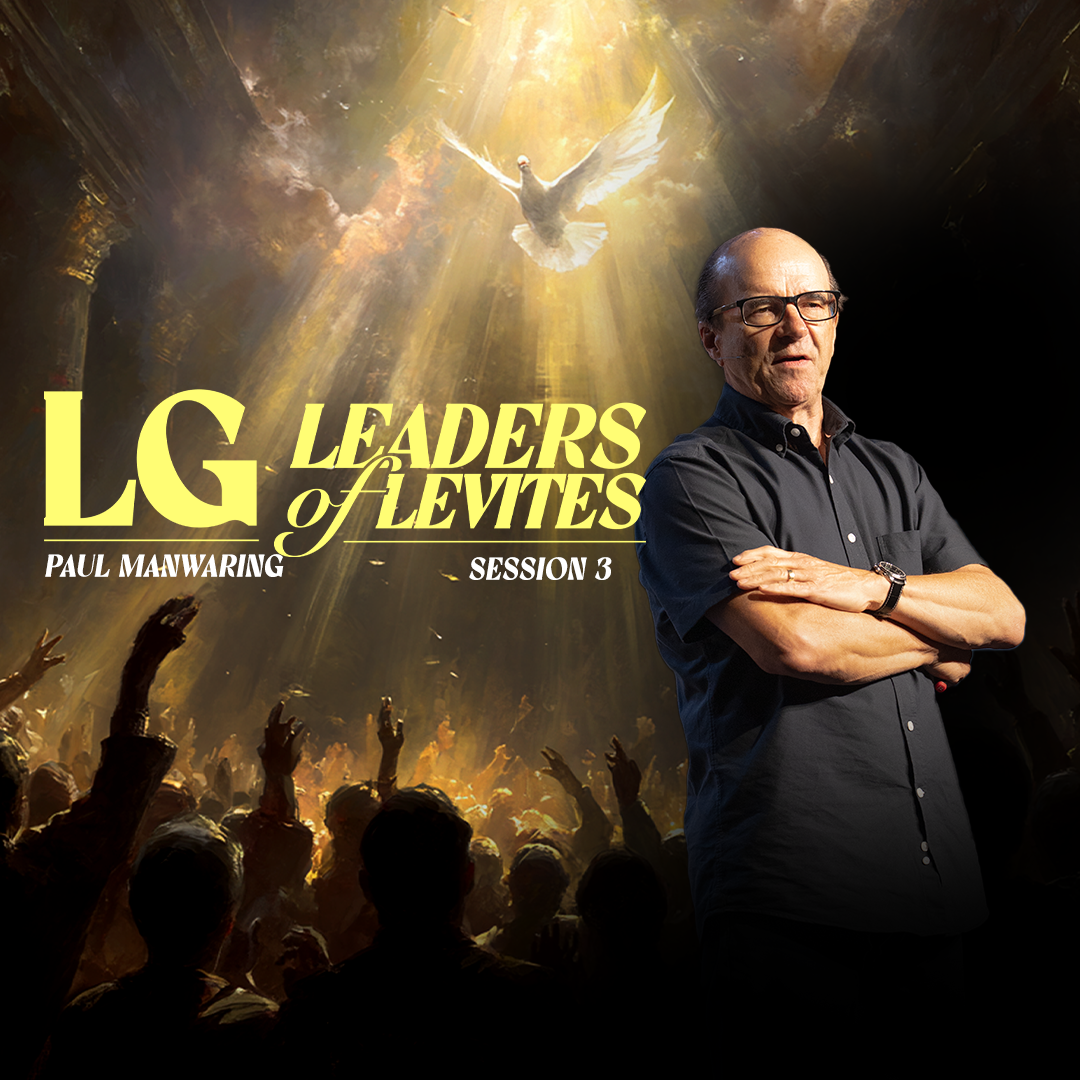
What are you going to do about it? First, if your church isn't primarily a place of the presence of God, which is really what the whole point of the title of these two days is. Leaders of Levites, their job was to look after the tabernacle, the temple they were putting up and tearing down. If you think you're the first generation to do set up and set down, no, they were doing it years ago.
And they followed the presence, the pillar of fire, the pillar of cloud. They knew where to stop. They set up everything. The tent, the tabernacle.
They gathered around the presence of God, and they gathered around that ark of the testimony which contained the power of God, Aaron's rod, the provision of God, the jar of manna, and the promises of God, the two lumps of stone, the Ten Commandments.
And they took care of that. And if we're leaders of Levites, this, as it were, is our tabernacle and this is the ark of the covenant. This is really what we're about taking care of. And if you walk away from here with, okay, we need an upgrade in worship in the presence of God, number one, take care of you. What is your personal worship life like?
What does that look like?
What do you call worship in your life?
What does it mean to describe yourself as a worshipper? I mean, trust me, I can't sing. I really can't sing.
The story is when, you know, we change churches. I think sue and I have been in a church 23 years.
She'd been in the worship team all of those 23 years. We changed churches. We went to a renewal church that Randy Clark had been to in Slough. And the first week she stood next to me and she said, oh, I'd forgotten how bad it was standing next to you in worship.
Thanks, my darling.
So I'm reasonably exuberant worshipper. I do tend to make some noise and I don't like to stand still too much.
So my worship will not be measured by the quality of my singing.
So I want to challenge you. What does that look like to you in your life for you to be described as a worshiper?
Because you're going to take a value and you're going to live that out and it's going to be a culture in your life before you then go to your organization, your church, your ministry and say, okay, we're going to shift this. So what does it look like in your structure?
Is it included in your, what you're building and how does it serve, why you're building it?
It's just a simple checklist.
But you can't leave it here because what we heard was if we become presence focused worshipping houses, we will see what we've been believing for because we put the priority right and we need to do that. And it doesn't depend on having a Joel, a Tim or whatever. It actually starts with me having a value for worship, valuing the presence of God.
Which means what I'm going to do is I'm going to talk about this, I'm going to teach on it.
I'm going to prepare series on it. I'm going to have my life groups talking and discussing worship.
I'm going to have songs that I'm going to send around to all the life group leaders and I'm going to say, I want you to play this song. I want you to lead your people to understand where this song came from, why it was written, where it's leading us to. In other words, you're going to create a culture of worship in your world and it's going to be in your structure because it's going to how you lead, steward and manage your organization.
It's going to be a part of what you're building, you're going to make space for it. And if it's part of what you're building, you are going to put money into it, you're going to invest in it because it's going to have budget subheads because it's part of what you're building, because you've got a worship department in your organization, we're going to put money in it.
Too many worship leaders are sort of almost nervously going to the leader and saying, is there any possibility that I can have a 45 year old second hand sold on ebay sound desk if it was at all possible? No, the leader should be going and saying what do you need?
And once you put it in your what and of course your why, your why is going to be stretching what you're doing.
Now the same would apply here with anything. You might go away from here with something else. You might say, I really believe that we need to have an increased culture of generosity. Say, okay, it's going to start with me, I need to shift on generosity in my value, I need to live it out. But then we're going to start to look at where is it? Somebody was saying yesterday they shifted in their church the offering from realizing that it was one of five things they were telling their church to do at the end of worship to pausing and going, no, if we really want to shift that, we're going to give it more space in the structure.
And so a very quick, very, very quick look at these four elements that are completely connected.
And I would just encourage all of you and obviously I have ways of teaching this that are far more detailed and go into detail and asking a lot more questions. But the simplicity is could you describe to someone who doesn't know your church or your ministry what you're building?
Do you have a description of your church?
Do you carry a mission of why you're doing it, the mandate you've been given from heaven for your village, town, city, region?
Do you have that and is it stretching your what do you have? Oh, I did say I was going to and I will just very quickly do the how piece. Do you know where you are on your organizational journey? And it always starts here. It starts with mum and pop, who are doing everything. It's the church plant. Yeah. You're working 168 hours a week and you do everything.
Yeah, maybe sometimes 178 hours a week. Okay.
And success means that you put enough food on the table to take care of the church and your family.
The next stage of your organization is called more of the same.
You've still got mom and Pop leading it and that. You've got people who are doing the parts. You know everyone and you know how to do everything.
But the last stage is the one that I've drawn over there, which is this, which is mum and Pop. But you're moving towards the functional departments, which is multiplication and diversification.
Do you know what season you're in? And you know the next season you need to be in? Because once you know the next season, you start recruiting the people to take care of the next season. And Steve has a genius thing on this, and what he pretty much says is, if this is. Until this gets to 150, all you do is recruit workers.
Once you get over 150, you recruit leaders.
See, understand what you're looking for when you know the stage of the organization.
So can you describe your what do you have a why?
Do you know what the structure is? And who's responsible for everything that you do in your ministry? And do you know the top three to five cultures that you need in this season to serve the changes that you're making? Because culture is the key to leading change.
If you want more healing, tell good news stories.
If you want more healing, pray for more sick people.
It's all about creating a culture, and it's the key to leading, stewarding, and managing the change. If you want more worship, then you create a culture of worship, and you will lead the change. And you'll probably attract the worship leaders because they'll start to hear, you know, if a worship leader comes to your church and sees three songs and it ends with the announcements and there's no space for creativity, they're not going to come back. But if they come and they see there's a high value for worship, they might stay.
So I just want to encourage you. Don't leave what you learn here.
Start to think, what do I do with this?
How do I create a culture, in this case of worship?
How am I going to make sure that it's in my structure that somebody's taking care of it? How am I going to put it into my vision, which is going to mean it's going to start to attract resources and time and attention from the senior team? And how does it serve the why? Why don't you stand and I'll pray for you?
Holy Spirit, would you just give us what we need?
And I ask personally that you would release from my life the gift of government, the gift of administration, that you would release it.
And your word says the government is on the shoulders of a son and father. I ask for that to be released. Ask for a release of the gift of government, the gift of administration, that we wouldn't just come to an event and get a nice idea, but that we would leave knowing what to do, how to put it into practice and how to build and how to come alongside you in building the church that you, Jesus, that said you would build. Would you give us the grace to do that? And may each one of us carry from this day this desire, this absolute desire that we would be houses of worship and of your presence. And as Bill says, for years the church has camped around the sermon and yet the people of Israel camped around the presence. May we get back to camping around your presence. And may everything we do serve that in Jesus name. Amen.
[00:44:10] Speaker A: Thanks for listening to the Coma Church Podcast. If you enjoyed this message, you can like and subscribe. You can also join us in person or online every Sunday at Cromer Church. For more information about us, including our ministries, events, worship and how to donate, visit our website at Cromer Church.
[00:44:32] Speaker B: Sam.